Marine and dredging equipment faces constant exposure to moisture, UV radiation, abrasion, chemicals, and temperature changes across Wisconsin and Minnesota
Saltwater can accelerate corrosion, but freshwater equipment isn’t immune to coating failure. Sediment, impact, prolonged moisture, road salt during transportation, and Minnesota and Wisconsin’s freeze-thaw cycles can all take a toll on exposed metal.
If you run dredgers, barges, or marine components, you’ve probably already replaced a paint job that failed years before it should have. Marine-grade powder coating solves that problem differently, and the difference shows up in how long your equipment lasts.
Rocket Powder Coating works with dredging and marine operators across Minnesota and Wisconsin, from crews running the St. Croix and Mississippi to inland lake and river operations throughout the region.
We coat cutterheads, trailing arms, deck hardware, railings, and structural frames built to survive years in the water, not months.
Powder Coating vs. Marine Paint: What’s the Difference?
| Factor | Powder Coating | Marine Paint |
| Application | Electrostatic application | Liquid spray/brush/roll |
| Curing | Heat-cured | Air or chemically cured |
| Finish consistency | Highly consistent when properly applied | Depends on application |
| VOCs | Generally low/no VOCs during application | Can contain VOCs |
| Abrasion resistance | Strong with the correct system | Varies by coating |
| Touch-up | More difficult to blend invisibly | Generally easier |
| Large field repairs | Less convenient | Often easier |
| Factory-controlled application | Excellent | Varies |
Why Paint Fails on Marine Equipment
Liquid paint cures as a single layer that’s only as strong as its thinnest spot. Runs, drips, and uneven coverage create weak points, and marine environments find those weak points fast.
Salt spray works into hairline gaps. UV breaks down the resin. Within a season or two, you’re looking at chalking, peeling, and rust creeping in at every seam.
Powder coating cures differently. The electrostatic application process helps provide consistent coverage when the part is properly prepared and positioned. Experienced application is especially important around corners, welds, edges, and recessed areas where coating coverage can be more challenging.
Heat curing then fuses that powder into a single continuous layer with no seams for water or salt to exploit.
A properly specified powder coating system can provide years of service before recoating is needed, although actual service life depends on exposure, surface preparation, coating specification, and equipment use.
What Makes Powder Coating Hold Up in Saltwater and Freshwater
Four properties do most of the work:
- Corrosion resistance. The continuous finish blocks moisture and salt from reaching bare metal, which is where rust starts.
- UV stability. Color holds instead of fading or chalking after a summer of direct sun on open water.
- Abrasion resistance. Cutterheads, suction pipes, and pump housings take constant contact with sediment, rock, and debris. Powder coating resists wear better than paint’s softer film.
- Chemical resistance. Fuel, oil, and salt spray don’t break down the finish the way they break down conventional paint.
For equipment exposed to water and weather between jobs, a durable finish can also make routine cleaning and maintenance easier. That won’t replace regular hull maintenance, but it cuts down on buildup on railings, ladders, and other above-water components.
Built for Minnesota Winters and Wisconsin Freeze-Thaw
Marine and dredging equipment in Minnesota and Wisconsin may not face ocean saltwater, but it still deals with prolonged moisture, sediment, chemicals, UV exposure, road salt during transportation, and repeated freeze-thaw cycles.
A properly specified powder coating system can withstand repeated temperature changes and outdoor exposure, making coating selection important for equipment stored through Minnesota winters and redeployed each spring.
Rocket Powder Coating serves industrial, marine, and dredging customers throughout Minnesota and Wisconsin. For equipment operating on the Mississippi River, St. Croix River, inland lakes, or other wet and abrasive environments, the right coating system can help reduce corrosion and maintenance requirements.
Rocket Powder Coating Process
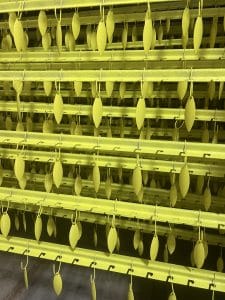
Every job starts with surface preparation. Marine equipment arrives with rust, old paint, oil, and scale, and none of that gets skipped over. We media blast every part down to bare, clean metal, because powder coating only performs as well as the surface underneath it.
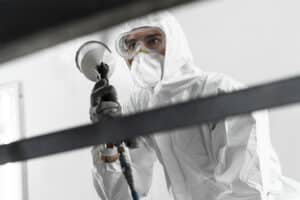
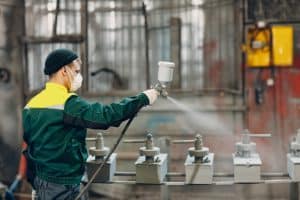
From there, we apply the powder electrostatically, cure it in a controlled oven environment, and inspect every piece before it ships. That inspection step catches thin spots or coverage gaps before equipment goes back into service, not after.
Marine and Dredging Equipment We Powder Coat
Rocket Powder Coating manages a wide range of dredging and marine components:
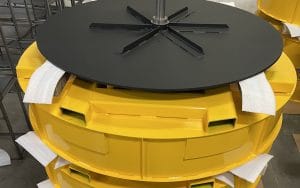
- Dredgers, cutterheads, suction pipes, pumps, and trailing arms
- Barge decks, railings, hatches, and engine components
- Marine structural steel, pilings, bulkheads, and dock hardware
- Offshore risers, racks, and pipeline supports
- Boat trailers and transport frames exposed to road salt and wet conditions
Get a Quote for Your Marine Equipment
Send us the parts, the exposure conditions, and the timeline, and we’ll walk you through a coating plan built for your equipment. Contact Rocket Powder Coating to get started.
Powder Coating FAQs
How long does powder coating last on marine equipment compared to paint?
Powder coating can provide years of service when the coating system is properly selected and applied. Actual service life depends on surface preparation, coating chemistry, thickness, UV exposure, moisture, abrasion, chemicals, and whether the equipment is submerged.
Can powder coating handle equipment that’s fully submerged?
Certain powder coating systems are suitable for immersion service, but the coating system needs to be specified for the operating environment.
Does powder coating come in custom colors for branding?
Yes. We offer a wide range of colors and finishes, so your fleet can stay identifiable and consistent across every piece of equipment.
What sizes of equipment can you coat?
We handle everything from small hardware and fittings up to large structural components and barge sections. Contact us with your specs and we’ll confirm capacity.
Is powder coating more expensive than paint upfront?
Initial cost runs comparable to or slightly higher than marine paint, but the extended lifespan and lower maintenance frequency typically make powder coating cheaper over the equipment’s service life.